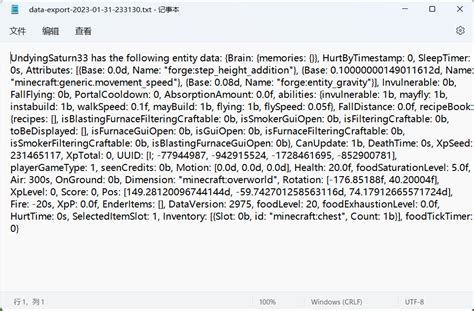
Unlock Minecraft’s Secrets: Open & Edit NBT Data## Diving Deep into Minecraft: Understanding NBT FilesHey there, fellow Minecraft enthusiasts! Ever wondered how your inventory items, your player stats, or even the precise details of a sign or a chest in your world are stored? Well, today, we’re going to
dive deep
into the fascinating world of
NBT files in Minecraft
. Understanding how to
open NBT files in Minecraft
isn’t just for the super tech-savvy modders; it’s a powerful skill that can unlock a whole new level of customization, troubleshooting, and pure fun in your game. We’re talking about direct access to the very DNA of your Minecraft world, allowing you to manipulate almost any aspect of it. Imagine giving yourself a super-enchanted pickaxe that’s
impossible
to get through normal gameplay, or fixing a corrupted player inventory without losing your entire progress. Maybe you want to create a custom map with unique item properties or automate complex redstone contraptions with precise data manipulation. This isn’t just about cheating; it’s about learning the internal workings of one of the most beloved games out there. For those of you who’ve always been curious about the
magic
behind the blocks, the
Named Binary Tag (NBT)
format is where much of that magic resides. It’s the structured way Minecraft stores all its intricate data, from the simplest block state to the most complex entity properties. So, buckle up, guys, because we’re about to embark on a journey that will demystify how Minecraft keeps track of literally everything, and more importantly, how
you
can get in there and tweak it to your heart’s content. We’ll explore why these files are so crucial, what they contain, and the essential tools you’ll need to safely access and modify them. Get ready to transform your understanding of Minecraft from a player’s perspective to that of a true digital architect.## What Exactly Are NBT Files, Anyway? The Core of Minecraft DataLet’s get down to brass tacks:
what are NBT files in Minecraft
? In the simplest terms, NBT stands for
Named Binary Tag
. It’s a file format developed by Mojang specifically for storing structured data used by Minecraft. Unlike plain text files or JSON, NBT is a binary format, which means it’s not designed to be easily readable by humans without a specialized tool. Think of it like a highly organized, hierarchical database specifically tailored for the game’s needs. Every single piece of dynamic data in your Minecraft world, from your player’s current health and experience points to the exact type of wood a chest is made of and what items are inside, is stored using this format. This includes everything from the
level.dat
file, which holds world-specific information like the seed, game rules, and spawn point, to individual chunk data files that store block information, entity data (mobs, items frames, armor stands), and tile entity data (chests, furnaces, signs, command blocks) within specific areas of your world. Player data is stored in separate
.dat
files for each player, containing inventory, position, health, and more. Even items themselves have NBT tags for enchantments, custom names, lore, and other unique properties.
Understanding the NBT format is crucial
for anyone looking to go beyond basic gameplay and truly customize their experience. It’s a tree-like structure, where each “tag” has a name, a type (like byte, short, int, long, float, double, string, list, or compound), and a value. These tags can be nested, creating complex data structures that perfectly represent the intricate state of your Minecraft world. Without NBT, Minecraft simply couldn’t remember anything between game sessions, making it an utterly essential part of the game’s architecture. It’s the silent workhorse behind every block placed, every item crafted, and every adventure you embark on. So, when we talk about
opening NBT files in Minecraft
, we’re talking about peeking under the hood of this powerful data storage system.## Why Would You Want to Open NBT Files in Minecraft? Unlocking PossibilitiesSo, you might be asking, “Why would I even bother to
open NBT files in Minecraft
?” Well, guys, the reasons are as vast and varied as the blocks in your world! Firstly, one of the most common motivations is for
deep customization and modification
. Imagine you want to create a unique item with custom enchantments that are otherwise impossible to obtain in survival mode, or give a sword a specific lore text for an adventure map. With NBT editing, you can directly modify these item tags. Secondly,
NBT editing is incredibly useful for troubleshooting and recovery
. Ever had a corrupted player data file that prevents you from loading your character, or a world where a specific chunk is causing crashes? Sometimes, directly accessing the NBT data can help you identify and fix the problematic tags, potentially saving hours of progress. It’s a last resort, but a powerful one. Thirdly, for
map makers and content creators
, NBT editing is a game-changer. You can pre-fill chests with specific loot, set up command blocks with complex NBT data for custom interactions, or create unique entities with altered attributes (like an invincible zombie or a flying pig). This allows for truly bespoke and immersive map experiences that wouldn’t be possible with in-game commands alone. Fourthly, it’s a fantastic way to
learn about game mechanics
. By examining the NBT data of blocks, entities, and items, you gain a deeper understanding of how Minecraft functions under the hood. You can see how enchantments are stored, how potion effects are applied, or how different block states are represented. This knowledge can then be applied to better redstone contraptions or more efficient farm designs. Finally, let’s be honest, sometimes it’s just for
fun and experimentation
. Want to see what happens if you set your player’s health to 1000? Or perhaps spawn an entity with ridiculous movement speed? NBT editing provides the tools to explore the boundaries of the game in ways that normal gameplay doesn’t allow. It empowers you to become a true architect of your Minecraft experience, moving beyond simply placing blocks to manipulating the very data that defines them. Whether you’re aiming for precision, recovery, creativity, or curiosity,
opening NBT files in Minecraft
is a skill that opens up a whole new realm of possibilities.## Essential Tools for Accessing and Editing NBT DataAlright, so we’ve established
why
you’d want to
open NBT files in Minecraft
, but
how
do you actually do it? Since these are binary files, you can’t just open them with Notepad. You’ll need specialized tools designed to interpret the NBT format. The absolute king of NBT editors, and the one we’ll primarily focus on, is
NBTExplorer
. This tool is a desktop application that provides a user-friendly graphical interface (GUI) for navigating and editing NBT data. It’s widely regarded as the safest and most reliable option for directly interacting with your Minecraft saves. Think of it as a file explorer specifically for NBT files, allowing you to browse through the complex nested tags with ease. NBTExplorer is powerful because it understands the structure of Minecraft’s data, helping you to avoid common errors. It clearly displays tag names, types, and values, and allows you to add, delete, or modify individual tags. While NBTExplorer is the go-to, there are other methods, though often less direct or more niche. For instance, some
online NBT editors
exist, but these typically require you to upload your
.dat
files to a website, which can be a significant security risk. We highly recommend
avoiding
these for sensitive game data. Additionally, for advanced users or developers, there are
programming libraries
available in languages like Python (e.g.,
nbtlib
,
nbt.py
) that allow you to programmatically read and write NBT files. This is incredibly powerful for creating automated scripts or custom tools, but it requires coding knowledge. Finally, for some simple NBT manipulation within the game, Minecraft’s own
/data
command
allows you to query and modify NBT data of specific blocks and entities in-game, without needing an external tool. However, this method is more limited in scope compared to NBTExplorer, which gives you a bird’s-eye view of your entire save structure. For beginners and most common use cases,
NBTExplorer
is your best friend. It’s robust, well-maintained, and designed specifically for the task of helping you
open NBT files in Minecraft
safely and efficiently. Always remember to download NBTExplorer from trusted sources (like its GitHub repository) to ensure you’re getting the legitimate, virus-free version.## Step-by-Step Guide: Using NBTExplorer to Manipulate Minecraft DataAlright, guys, this is where the rubber meets the road! We’re going to walk through the process of how to
open NBT files in Minecraft
using our trusty tool, NBTExplorer.
Before you even think about starting, here’s your golden rule
:
ALWAYS BACK UP YOUR MINECRAFT SAVES!
Seriously, I cannot stress this enough. Editing NBT data incorrectly can corrupt your world or player data, and without a backup, you could lose hours of progress. Just copy your entire world folder to a safe place before you begin.### Getting Started with NBTExplorerFirst things first, you need to download NBTExplorer. Head over to its official GitHub repository (a quick search for “NBTExplorer GitHub” should get you there). Download the latest executable for your operating system. Once downloaded, it’s usually a standalone
.exe
file on Windows, so no installation is required – just run it!### Navigating Your Minecraft SavesWhen you launch NBTExplorer, you’ll see a tree-like structure. It usually automatically detects your Minecraft saves folder, but if not, you might need to navigate there manually. The typical path is:*
Windows
:
%appdata%\.minecraft\saves
*
macOS
:
~/Library/Application Support/minecraft/saves
*
Linux
:
~/.minecraft/saves
Inside the
saves
folder, you’ll find individual folders for each of your Minecraft worlds. Double-click on the world you want to edit.### Understanding NBT StructureOnce you open a world folder in NBTExplorer, you’ll see several key files and folders:*
level.dat
: This is the
main brain
of your world. It contains global settings like the world seed, game rules, spawn point, time of day, and generator options. You’ll often find yourself editing this for general world tweaks.*
playerdata
: This folder contains
.dat
files for each player in the world (named after their UUID). These files hold crucial player-specific data like inventory, health, experience, position, and statistics.*
region
/
DIM-1
/
DIM1
: These folders contain the actual chunk data for the Overworld, Nether, and End dimensions, respectively. Inside, you’ll find
r.x.z.mca
files, which store block data, entities, and tile entities (chests, furnaces, signs, etc.) for specific regions of your world.*
data
: This folder might contain other specialized NBT files, such as those for structures, advancements, or custom data packs.To
open NBT files in Minecraft
means navigating this structure. For example, to edit your player’s inventory, you’d expand your world folder, then
playerdata
, then find your player’s UUID
.dat
file and open it. Inside, you’ll see a
Compound
tag containing various sub-tags like
Pos
(position),
Health
,
XpP
(experience progress), and most importantly,
Inventory
. The
Inventory
tag will be a
List
of
Compound
tags, each representing an item with its own NBT data (ID, Count, Slot, and potentially
tag
for enchantments, names, etc.).### Making and Saving Changes SafelyLet’s say you want to give yourself more hearts. You’d open your player’s
.dat
file, find the
Health
tag, right-click it, select “Edit Value,” and change the number (e.g., from 20 to 40 for 20 hearts). Or, if you want to add a custom item, you could navigate to the
Inventory
list, right-click, select “Add Tag” -> “Compound Tag,” and then fill in its
id
,
Count
,
Slot
, and
custom_name
tags.When modifying existing tags:1. Select the tag you want to change.2. Right-click and choose “Edit Value.“3. Enter the new value.4. Press Enter or click “OK.“When adding new tags:1. Right-click on the parent
Compound
or
List
where you want to add the tag.2. Select “Add Tag” and choose the appropriate tag type (e.g., “Compound Tag” for an item, “String Tag” for a name).3. Give the new tag a name and value as needed.
Crucial tip
: Always make small, incremental changes, and save frequently (File -> Save) while checking in-game to see if your changes had the desired effect. If something goes wrong, you can always revert to your backup. Be incredibly careful when deleting tags; if you delete a critical tag, you might corrupt the entire file. When you’re done, remember to save your changes in NBTExplorer (File -> Save) and then close the program. Launch Minecraft, and your changes should be there! The power to directly modify these files is immense, so wield it responsibly and always, always keep those backups handy, guys. This hands-on experience is the best way to truly grasp the potential of NBT editing.## Advanced NBT Tips and Tricks for Power UsersAlright, for those of you who’ve mastered the basics of how to
open NBT files in Minecraft
and are ready to push the boundaries, let’s talk about some advanced tips and tricks. NBT editing isn’t just for basic inventory changes; it’s a powerful tool for truly transforming your game and maps. One of the coolest advanced uses is for
command block customization
. When you place an item or block via a command, you can specify its NBT data directly. For example, using the
/give
command with NBT allows you to create items with custom names, lore, enchantments, unbreaking properties, or even specific block data for
BlockEntityTag
. This is invaluable for map makers who want to distribute unique, custom-designed tools or weapons that don’t exist naturally. You can craft incredibly detailed items this way, setting up custom display names with colors, specific attack damage modifiers, and more. Understanding the precise NBT structure for these items in NBTExplorer will help you formulate the correct
/give
command syntax. Another powerful technique is
exploring entity and block NBT data in detail
. While
/data get block
and
/data get entity
commands in Minecraft can show you NBT data in-game, NBTExplorer gives you a much better overview and allows for direct editing. You can modify mob attributes (like health, movement speed, or attack damage), change the contents of a spawner, or alter the properties of an armor stand to hold specific items or appear invisible. For instance, to make an armor stand unbreakable or invisible for a cinematic, you’d find its NBT entry in a chunk file, locate the
Invisible
or
Invulnerable
tag, and set its byte value to
1b
.
Troubleshooting complex issues
also frequently involves advanced NBT knowledge. If a modded item is causing a crash, examining its NBT data might reveal a malformed tag or an incompatible property that can be corrected. Or, if a player is stuck in a loop due to a corrupted position tag, NBTExplorer can be used to manually reset their
Pos
tag to a safe location. Finally, NBT editing goes hand-in-hand with
data packs
. Data packs allow you to add custom recipes, advancements, loot tables, and even modify world generation. Many elements within data packs rely on precise NBT data for their functionality. For example, a custom loot table might require items with specific NBT tags to be dropped. Using NBTExplorer to inspect existing item NBT or to design the NBT for your custom items is an essential skill for data pack creation. By diving deeper into these advanced applications, you’ll unlock the full potential of NBT, transforming your Minecraft experience from simply playing the game to truly mastering its underlying mechanics. Just remember, with great power comes great responsibility – always back up your worlds and experiment cautiously!## Conclusion: Master the NBT, Master Your Minecraft WorldWell, guys, we’ve covered a lot of ground today! We started by understanding what
NBT files in Minecraft
truly are—the binary heart of your game’s data—and explored the myriad reasons why anyone, from casual players to dedicated map makers, would want to
open NBT files in Minecraft
. From troubleshooting corrupted saves and recovering lost progress to crafting unique custom items and designing intricate command block systems, the ability to interact directly with NBT data empowers you like never before. We’ve introduced you to NBTExplorer, the indispensable tool that transforms cryptic binary data into an understandable, editable format, guiding you through the step-by-step process of navigating your Minecraft saves, understanding the hierarchical NBT structure, and making safe, effective changes. We also touched upon advanced applications, showcasing how NBT knowledge can elevate your command block creations, fine-tune entity behaviors, and even assist in complex data pack development. The journey into NBT editing is one of discovery, offering a deeper appreciation for the intricate engineering behind Minecraft. It’s a skill that grants you unprecedented control over your game world, allowing you to tailor your experiences, create truly unique content, and solve problems that seem insurmountable through regular gameplay. Remember, however, that with this immense power comes a significant responsibility. The digital integrity of your Minecraft worlds rests in your hands, and incorrect edits can lead to unforeseen issues. Therefore, the cardinal rule of NBT editing—
always back up your saves
—should be etched into your mind. Approach NBT editing with curiosity, caution, and a spirit of experimentation, and you’ll find that it unlocks a whole new dimension of creativity and control within your favorite blocky universe. So go forth, intrepid adventurers, and master the NBT! Your Minecraft world is waiting to be shaped, refined, and customized exactly how
you
envision it. The power is now yours!
