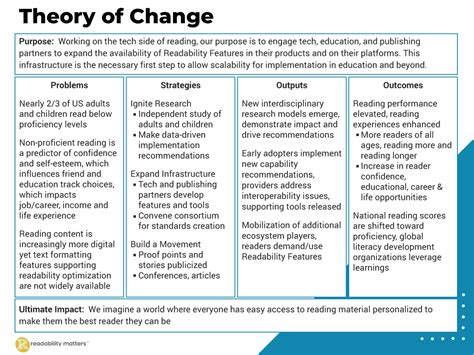
Theory of Change: Your Guide to Impactful Strategies\n\nHey there, awesome people! Ever wondered how some projects just
nail
their goals, while others… well, not so much? A big secret behind those wildly successful initiatives often lies in something called a
Theory of Change
(ToC). So, what
is
Theory of Change, and why should you, a project manager, a community leader, an innovator, or just someone passionate about making a difference, absolutely care about it? Simply put, a Theory of Change is like your super-detailed, step-by-step roadmap that shows exactly
how
and
why
your planned activities will lead to the outcomes you hope to achieve. It’s not just a list of tasks; it’s a living, breathing hypothesis about cause and effect. Think of it as painting a clear, logical picture of the journey from where you are now to that magnificent future you’re aiming for. It helps you articulate not just
what
you’re going to do, but
why
you believe it will work, taking into account all the complex factors at play. This isn’t some dry, academic exercise, folks. This is about making your impact real and measurable. Many organizations, from global NGOs to grassroots community groups, are embracing the Theory of Change because it brings much-needed clarity, focus, and strategic alignment to their efforts. It forces you to think critically about the underlying assumptions that drive your work and to explicitly state the links between your interventions and the desired societal changes. By doing this, you’re not just crossing your fingers and hoping for the best; you’re building a robust framework that allows for continuous learning and adaptation. So, if you’re serious about creating lasting change and want to stop guessing and start strategizing with confidence, stick around. We’re going to dive deep into making Theory of Change your ultimate tool for success.\n\n## Why Do We Need a Theory of Change?\n\nAlright, guys, let’s get down to the brass tacks:
why
exactly do we need a
Theory of Change
? Isn’t a simple action plan enough? The short answer is, no, not if you’re serious about achieving lasting, meaningful impact and want to understand the
mechanisms
behind that change. A Theory of Change isn’t just another piece of paperwork; it’s an absolutely fundamental tool that brings clarity, coherence, and accountability to any project or program. First off, it significantly
enhances strategic planning
. Instead of just listing activities, a ToC compels you to think backward from your ultimate long-term goals and then forward through the intermediate outcomes to the activities required. This “backward mapping” approach ensures that every single action you plan is directly linked to the desired change, making your strategy incredibly focused and efficient. You avoid wasting resources on activities that don’t contribute to your core objectives. Secondly, a robust
Theory of Change
dramatically improves
communication and alignment
among stakeholders. Imagine a team where everyone has a crystal-clear understanding of the project’s vision, how it will achieve its goals, and their specific role in that journey. That’s what a ToC facilitates! It creates a shared mental model, ensuring that funders, partners, staff, and beneficiaries are all on the same page, speaking the same language, and working towards a common understanding of success. This shared vision minimizes misunderstandings, builds stronger collaborations, and ensures that everyone is pulling in the same direction, which is super important for complex projects. Furthermore, a Theory of Change is invaluable for
monitoring, evaluation, and learning
. It provides a clear framework for identifying what to measure and why. Because your ToC explicitly outlines the causal pathways and expected outcomes at each stage, it becomes much easier to design relevant indicators and track progress. If something isn’t working as planned, the ToC helps you pinpoint exactly where the breakdown might be – is an assumption flawed? Are the activities not leading to the intermediate outcomes? This diagnostic capability is priceless. It transforms evaluation from a mere judgment of success or failure into a powerful
learning opportunity
, allowing you to adapt your strategy, iterate, and ultimately increase your chances of achieving your long-term goals. Without a ToC, evaluations can feel like shooting in the dark; with it, you have a well-lit path to follow and refine. It truly makes your work more effective, transparent, and ultimately, more impactful. This foundational understanding is what elevates good intentions into great outcomes, helping you build truly transformative initiatives that stand the test of time and scrutiny. So, if you’re asking yourself “why ToC?”, the answer is simple: it’s your best bet for turning vision into verifiable reality and ensuring every effort counts.\n\n## Key Components of a Theory of Change\n\nAlright, friends, let’s peel back the layers and explore the
nuts and bolts
that make up a powerful
Theory of Change
. Understanding these key components is crucial because they are the building blocks that allow you to construct a clear, coherent, and compelling narrative of change. Think of them as the essential ingredients in your recipe for impact. Neglect one, and your whole recipe might fall flat!\n\n### Long-term Outcomes\n\nFirst up, we have the
Long-term Outcomes
. These are the big, audacious goals, the ultimate societal changes you envision. What does success truly look like in the grand scheme of things, typically three to five or even ten years down the line? These aren’t just vague hopes; they should be
specific, measurable, achievable, relevant, and time-bound
(SMART) statements of the desired change. For instance, instead of “people will be healthier,” a long-term outcome might be “By 2030, the incidence of preventable diseases in Region X will decrease by 50% among children under five.” This isn’t something you can achieve overnight, but it’s the destination your entire Theory of Change is geared towards. It sets the overarching vision and provides the ultimate benchmark for your success.\n\n### Intermediate Outcomes\n\nNext, we break down those big dreams into smaller, more manageable steps called
Intermediate Outcomes
. These are the crucial changes that
must
happen along the way to reach your long-term goal. Think of them as milestones or stepping stones. If your long-term goal is to reduce preventable diseases, an intermediate outcome might be “Increased access to clean drinking water in Region X communities” or “Improved knowledge of hygiene practices among caregivers.” These outcomes are often achieved within a shorter timeframe (e.g., 1-3 years) and are directly influenced by your project’s activities. They represent the necessary shifts in knowledge, attitudes, behaviors, practices, or conditions that are logically linked to the higher-level outcome. Explicitly mapping these out helps you see the incremental progress and understand the logical flow of change.\n\n### Activities/Interventions\n\nNow, how do you make those intermediate outcomes happen? That’s where your
Activities/Interventions
come in! These are the specific actions, programs, services, or initiatives that your project will
directly undertake
. These are the things you actually
do
. Following our example, activities could include “Installing water purification systems in village A,” “Conducting hygiene education workshops for mothers,” or “Distributing soap and handwashing guides.” Each activity should be strategically designed to directly contribute to one or more intermediate outcomes. This is where your resources, time, and effort are invested, so ensuring a strong, logical link between your activities and the desired outcomes is paramount. This connection is what ensures your efforts are purposeful and not just busywork.\n\n### Assumptions\n\nHere’s where it gets really interesting, folks:
Assumptions
. These are the underlying beliefs, conditions, or external factors that you
assume
must be true for your causal pathway to hold. They are often unstated but critical. For example, if you’re installing water purification systems, an assumption might be “Community members will
use
the purification systems consistently” or “The local government will maintain the infrastructure after the project ends.” If these assumptions don’t hold true, your whole Theory of Change might unravel! Explicitly stating your assumptions allows you to test them, monitor them, and develop contingency plans if they prove false. It’s about being
realistic
and acknowledging the external environment you’re operating within. Ignoring assumptions is like building a house without checking the foundation – risky business, right?\n\n### Indicators\n\nHow will you know if you’re making progress or if your outcomes are being achieved? That’s where
Indicators
step in. These are the specific, measurable pieces of evidence that tell you whether an outcome has occurred or an activity has been completed. For “Increased access to clean drinking water,” an indicator could be “Number of households with access to functioning water purification systems” or “Percentage increase in daily clean water consumption per household.” For “Improved knowledge of hygiene practices,” an indicator might be “Percentage of mothers who can correctly demonstrate proper handwashing techniques.” Indicators provide the data points necessary for monitoring and evaluation, allowing you to track your journey and assess your impact. They turn your abstract goals into concrete, verifiable realities.\n\n### Causal Pathways\n\nFinally, weaving all these components together is the
Causal Pathway
. This is the “if-then” logic, the narrative that explicitly links your activities to intermediate outcomes, and intermediate outcomes to long-term outcomes, all while considering your assumptions. It’s the story of
how
change will unfold. For example: “IF we conduct hygiene education workshops (activity), THEN mothers’ knowledge of hygiene practices will improve (intermediate outcome), which IF combined with increased access to clean water (another intermediate outcome) AND IF community members consistently use purification systems (assumption), THEN the incidence of preventable diseases will decrease (long-term outcome).” This logical chain is the heart of your ToC, demonstrating the step-by-step connections and the hypothesized sequence of events that lead to your desired change. It’s the full picture that ties everything together, allowing you and others to understand the entire journey from input to impact. Together, these elements form a comprehensive and powerful framework, enabling you to not just plan, but to genuinely understand and adapt your path to creating significant, lasting change.\n\n## Building Your Own Theory of Change: A Step-by-Step Guide\n\nAlright, team, now that we’ve got a handle on
what
a
Theory of Change
is and
why
it’s so incredibly useful, let’s roll up our sleeves and talk about
how
you can actually build one for your own project or initiative. Don’t worry, it’s not rocket science, but it does require some thoughtful effort and often, a good dose of collaborative thinking. This isn’t a solo mission, guys; it’s best done with your team, stakeholders, and even beneficiaries contributing their insights. Here’s a practical, step-by-step guide to get you started on crafting your very own powerful ToC.\n\n
Step 1: Define Your Long-Term Outcome (The BIG Vision)
The absolute first thing you need to do is clearly articulate your ultimate goal. What’s the
Theory of Change
trying to achieve in the long run? Ask yourselves:
What is the significant, measurable, and sustainable change we want to see in the world as a result of our efforts, say, in 5-10 years?
Be ambitious but realistic. This long-term outcome should be the North Star guiding your entire process. For example, instead of “improve education,” aim for something like “Increase literacy rates by 25% among primary school-aged children in the rural districts of X by 2028.” Getting this clear and agreed upon is absolutely crucial because every subsequent step will build upon it. This requires deep discussions and a shared understanding among all involved parties, ensuring everyone is aligned on the ultimate destination before plotting the route.\n\n
Step 2: Work Backwards: Identify Your Intermediate Outcomes (The Stepping Stones)
Once you have your long-term outcome, the next step in building your
Theory of Change
is to work backward. Ask:
What needs to happen, what changes in behavior, knowledge, skills, or conditions must occur for our long-term outcome to be achieved?
These are your intermediate outcomes. They are the essential preconditions. Don’t jump straight to activities yet! Focus on the
results
that must materialize. For our literacy example, intermediate outcomes could be: “Increased access to quality reading materials,” “Improved teaching methodologies in schools,” “Increased parental engagement in children’s learning,” or “Reduced incidence of school absenteeism.” You might find yourself brainstorming multiple layers of intermediate outcomes, forming a chain where one outcome leads to the next, building up to the long-term vision. This backward mapping technique is super effective for ensuring all necessary steps are considered and nothing is overlooked in the change process.\n\n
Step 3: Define Your Activities/Interventions (What You Will DO)
Now that you know the outcomes you need to achieve, you can start identifying the
Activities/Interventions
that will directly contribute to those intermediate outcomes. Ask yourselves: *What specific programs, services, or actions will
we
implement to bring about each intermediate outcome?* For “Increased access to quality reading materials,” your activities might include “Establish community libraries,” “Distribute age-appropriate books to homes,” or “Develop and publish local language storybooks.” Remember, each activity should have a clear, logical link to at least one intermediate outcome. This step is about defining your project’s core work, ensuring every effort has a purpose and contributes directly to the change you seek. This is where your operational plan starts to take shape within the strategic framework of the ToC.\n\n
Step 4: Articulate Your Assumptions (The ‘If-Then’ Conditions)
This is often the most overlooked yet critical part of building a strong
Theory of Change
. For each causal link (Activity -> Intermediate Outcome, or Intermediate Outcome -> Intermediate Outcome), identify the
Assumptions
that must hold true for that link to work. Ask:
What external factors, beliefs, or conditions must be in place or must occur for this step to lead to the next?
For example, if you’re distributing books, an assumption might be “Parents will encourage reading at home.” Or, if you’re training teachers, “Teachers will apply new methodologies in the classroom.” Be brutally honest about these. Challenge them! If an assumption is risky, consider how you might mitigate that risk or gather evidence to confirm it. Explicitly stating assumptions helps you prepare for potential roadblocks and makes your ToC much more robust and realistic. It also makes your monitoring and evaluation more targeted, as you can track whether these critical assumptions are indeed holding true, allowing for timely adjustments.\n\n
Step 5: Identify Your Indicators (How You’ll Measure Progress)
For every outcome (intermediate and long-term) and potentially even for key activities and assumptions, you need to define
Indicators
. These are your measurable checkpoints. Ask:
How will we know if this outcome has been achieved? What data will tell us we are making progress?
For “Increased literacy rates,” an indicator could be “Average score on standardized literacy tests for target children.” For “Improved teaching methodologies,” it could be “Percentage of observed lessons demonstrating new techniques.” Indicators should be SMART. They turn your abstract goals into concrete, verifiable data points, making your
Theory of Change
actionable and accountable. They are essential for demonstrating impact and for learning what’s working and what’s not, providing the feedback loop needed for continuous improvement. Remember, a well-defined ToC isn’t just a static document; it’s a dynamic guide for action and learning, empowering you to navigate the complexities of social change with greater confidence and effectiveness. Get your team together, grab some sticky notes, and start mapping it out – you’ll be amazed at the clarity it brings!\n\n## Common Pitfalls and How to Avoid Them\n\nAlright, folks, so you’re pumped about building your
Theory of Change
, and that’s fantastic! But like any powerful tool, there are ways to misuse it or stumble along the path. Understanding these common pitfalls isn’t about scaring you off; it’s about empowering you to create an even stronger, more effective ToC. Let’s talk about some of these traps and, more importantly, how to skillfully sidestep them, ensuring your strategic efforts truly hit the mark. Avoiding these mistakes will make your Theory of Change a living, breathing guide, rather than just another document gathering dust.\n\nOne of the biggest blunders people make is creating a
Theory of Change that’s too generic or vague
. It’s easy to fall into the trap of using broad statements like “improve livelihoods” or “empower communities.” While these are noble goals, they lack the specificity needed to be actionable. A vague ToC doesn’t give you clear guidance on what to measure or what activities are truly essential.
To avoid this
, challenge every statement. Ask “how?” and “why?” repeatedly. Push for concrete, measurable outcomes and explicit causal links. Instead of “improve health,” specify “reduce incidence of malaria by X% in Y district through Z intervention.” The more precise you are, the more useful your ToC will be. Remember, the power is in the details, not in generalizations. Don’t be afraid to get specific; that’s where the real magic happens.\n\nAnother common mistake is developing a
Theory of Change in isolation
, without involving key stakeholders. It’s tempting for project managers or a small core team to lock themselves in a room and hash it out, but this is a recipe for disaster. A ToC developed in a vacuum often misses critical perspectives, ignores local realities, and leads to a lack of buy-in from those who are meant to implement it or benefit from it.
To avoid this
, make the ToC development process highly participatory. Bring in community members, frontline staff, partners, and even funders. Their insights are invaluable, ensuring the ToC is relevant, realistic, and owned by everyone. Facilitate workshops, use visual mapping techniques, and encourage open dialogue. A collectively owned ToC is far more robust and has a much higher chance of success because it reflects a shared understanding and commitment from the ground up, not just a top-down mandate. This collaborative approach also enriches the thinking process, identifying assumptions and pathways that might otherwise be overlooked.\n\nThen there’s the issue of
treating the Theory of Change as a static document
. Some folks develop it at the beginning of a project, file it away, and never look at it again. This completely undermines its purpose as a
learning and adaptive tool
. The world is dynamic, guys! Contexts change, assumptions might prove false, and new opportunities or challenges will emerge.
To avoid this
, view your ToC as a living document. Schedule regular reviews – perhaps quarterly or annually – with your team and stakeholders. Use evaluation data to test your causal pathways and assumptions. If evidence suggests a link isn’t holding, be brave enough to adjust your ToC. It’s okay to iterate and refine! In fact, it’s
essential
for maximizing impact. This iterative approach fosters a culture of continuous learning and ensures your strategy remains relevant and effective throughout the project lifecycle. Don’t be afraid to question and adapt; that’s a sign of a truly intelligent and responsive initiative.\n\nFinally, many people tend to
confuse a Theory of Change with a Logframe (Logical Framework)
. While both are planning tools, they serve different purposes and have different levels of detail. A Logframe is more focused on project inputs, outputs, outcomes, and impact, often in a tabular format, and is primarily for accountability and reporting. A
Theory of Change
, on the other hand, delves deeper into the
why
and
how
, explicitly articulating the causal pathways, underlying assumptions, and the entire logical narrative of change. It’s a more explanatory, hypothesis-driven model.
To avoid this confusion
, understand that your ToC often
informs
your Logframe. The ToC provides the conceptual backbone and the detailed “story” of change, from which a more concise Logframe for monitoring and reporting can be derived. Don’t try to cram all the richness of a ToC into a Logframe; appreciate them as complementary tools. Use the ToC for strategic thinking, learning, and adaptation, and the Logframe for operational planning and accountability. By steering clear of these common pitfalls, you’ll not only create a more robust and effective Theory of Change but also cultivate a more adaptive, insightful, and impactful approach to all your initiatives. It’s about working smarter, not just harder, to achieve the change you envision.\n\n## Theory of Change in Action: Real-World Examples\n\nOkay, guys, we’ve talked about
what
a
Theory of Change
is,
why
it’s indispensable, and
how
to build one. Now, let’s bring it to life with some real-world-ish examples to show you just how versatile and powerful this framework can be across different sectors. Seeing it in action helps solidify the concept and hopefully sparks some ideas for your own incredible work. These examples illustrate how the “if-then” logic plays out, linking interventions to long-term impact through a series of logical steps, always underpinned by crucial assumptions. Remember, a strong ToC isn’t just about documenting what you plan to do; it’s about making explicit the
story
of change you expect to unfold, and why you believe it will happen, enabling focused action and continuous learning.\n\n### Example 1: Improving Child Literacy in a Rural Community\n\nLet’s imagine an organization aiming to boost
child literacy
in a remote rural community. Their
long-term outcome
is:
“By 2028, 80% of primary school children in the XYZ district will achieve age-appropriate reading proficiency.”
Sounds great, right? Now, how do they get there? Their
Theory of Change
might look something like this in terms of causal pathways:\n\n*
Activity:
If
the organization establishes and stocks community reading centers with diverse, age-appropriate books and hires local literacy facilitators,
then
…\n*
Intermediate Outcome 1 (Knowledge/Access):
…Children will have increased access to engaging reading materials outside of school, and local facilitators will provide supplementary reading support.\n*
Activity:
If
the organization conducts workshops for parents on the importance of reading and simple home-based literacy activities,
then
…\n*
Intermediate Outcome 2 (Behavioral Change):
…Parents will be more engaged in their children’s learning and encourage reading at home, creating a supportive literacy environment.\n*
Activity:
If
the organization trains local primary school teachers in phonics-based teaching methods and provides continuous coaching,
then
…\n*
Intermediate Outcome 3 (Systemic Change):
…Teachers will adopt more effective and engaging literacy instruction techniques in classrooms, leading to improved classroom learning outcomes.\n*
Combining Outcomes:
If
children have better access to materials (IO1),
and
parents support reading at home (IO2),
and
teachers use improved methods (IO3),
then
…\n*
Long-term Outcome:
…Children’s reading proficiency will significantly improve, leading to the overall long-term goal.\n\n
Crucial Assumptions:
For this to work, the organization assumes:
Parents have enough time and interest to participate in workshops and support home reading; Teachers are willing and able to adopt new methods; The community values literacy and actively utilizes the centers; Children are consistently attending school.
If any of these assumptions falter, the ToC provides a clear point to investigate and adapt. This detailed breakdown allows them to measure progress at each stage and understand
why
their efforts are expected to lead to better literacy, making their strategy both robust and adaptable. This systematic approach ensures that every intervention is purpose-driven, creating a powerful synergy that maximizes the potential for enduring change. It’s a beautifully crafted plan where every piece fits, guiding them towards a brighter future for the kids.\n\n### Example 2: Promoting Sustainable Agriculture Practices\n\nConsider a non-profit working with farmers to promote
sustainable agriculture practices
to improve environmental health and farmer livelihoods. Their
long-term outcome
is:
“By 2030, smallholder farmers in Region Y will adopt climate-resilient and environmentally friendly farming techniques, leading to improved soil health and increased income.”
How do they map out this complex change?\n\n*
Activity:
If
the organization provides training and practical demonstrations on organic composting, intercropping, and water-efficient irrigation,
then
…\n*
Intermediate Outcome 1 (Knowledge/Skills):
…Farmers will gain knowledge and practical skills in sustainable farming techniques and understand their benefits.\n*
Activity:
If
the organization facilitates access to micro-loans for purchasing organic seeds and drought-resistant crops,
then
…\n*
Intermediate Outcome 2 (Access/Resources):
…Farmers will have the financial resources and inputs needed to implement new practices.\n*
Activity:
If
the organization establishes farmer-to-farmer learning networks and peer support groups,
then
…\n*
Intermediate Outcome 3 (Behavioral Change/Peer Support):
…Farmers will share experiences, learn from each other, and feel more confident adopting innovative techniques.\n*
Combining Outcomes:
If
farmers gain skills (IO1),
and
have resources (IO2),
and
receive peer support (IO3),
then
…\n*
Intermediate Outcome 4 (Practice Change):
…Farmers will consistently adopt and implement sustainable agriculture practices on their farms.\n*
Long-term Outcome:
…Leading to improved soil health, increased yields, and higher incomes, achieving the ultimate goal.\n\n
Crucial Assumptions:
This ToC relies on assumptions like:
Farmers are willing to experiment with new methods despite initial risks; Local markets will accept and value organically grown produce; Climate patterns remain predictable enough for planning; Government policies do not hinder sustainable practices.
These examples clearly demonstrate that a
Theory of Change
isn’t just an academic exercise; it’s a practical, actionable blueprint that brings intentionality and measurability to efforts aimed at creating profound social and environmental impact. It allows organizations to communicate their strategy clearly, monitor their progress effectively, and adapt their approaches when needed, moving from good intentions to tangible, lasting change. It’s truly a game-changer for anyone serious about making a difference.\n\n## Conclusion\n\nSo there you have it, awesome people – our deep dive into the world of
Theory of Change
! By now, you’ve hopefully grasped that a ToC is much more than just a fancy planning tool; it’s a
transformative framework
that empowers you to think critically, plan strategically, and act intentionally towards creating the impact you envision. We’ve explored what it is – a detailed hypothesis of how your activities lead to outcomes – and why it’s absolutely vital for clarity, alignment, and effective learning within any initiative. From dissecting its key components like long-term goals, intermediate outcomes, specific activities, and the all-important assumptions, to walking through a step-by-step guide for building your own, and even pointing out common pitfalls to avoid, we’ve covered a lot of ground. The real magic, guys, lies in its ability to make the invisible visible: to articulate the often-unspoken logic behind your work, to challenge your assumptions, and to provide a clear, testable roadmap for success. It shifts you from simply
doing
things to
understanding
how those things contribute to the bigger picture, allowing for more adaptive and effective strategies. Whether you’re working on a small community project or a large-scale international program, embracing the Theory of Change will undoubtedly elevate your efforts, making your path to impact clearer, your learning richer, and your results more profound. It’s about moving from good intentions to great, verifiable outcomes. So go forth, build your Theories of Change, and start making that lasting difference you’ve always dreamed of. You’ve got this!
